If you have to periodically cleanse and validate market data within a specific time window, and keep an audit trail of your validation workflow, you can use Xplain’s anomaly detection module for market data (standard market data or TRS market data).
You can also use our valuation data anomaly detection module or our trade onboarding module, which are based on a similar methodology.
On this page, we will set out:
- how to set up the example market data environment (to replicate the worked example)
- how to start a market data cleansing workflow by creating a dashboard
- monitor the progress of the workflow via the dashboard
- how to generate Xplain valuation data at the end of the market data cleansing workflow, for use in a valuation data cleansing workflow, if Xplain is one of the valuation data providers
- how to re-run a (selection of) data cleansing stream(s)
You can view and export the results of the data cleansing process “as-you-go”, including raw, preliminary cleansed and overlay cleansed data (as described in the key steps of the workflow) and corresponding market data sources.
The Prerequisites
In terms of generic prerequisites, you can refer to or use the predefined break tests and task allocation settings, as described in the sandbox environment.
Completed Dashboard Example
You can view a completed dashboard related to the ‘3PM LONDON’ market data group (linked to the ‘BLUESTONE’ company) or to the ‘COB LONDON’ market data group (linked to the ‘LONDON_FICC’ company). Alternatively, you can replicate the completed ‘COB LONDON’ dashboard by starting your own MD XM workflow.
This page will guide you through the process using an example: running the anomaly detection process as at 30 November 2022 on ‘NEW MARKET DATA GROUP’ and ‘NEWCOMP’, after uploading “corrupted” EUR 10y swap rate (vs. EURIBOR 6M) data.
The .CSV import files with the relevant data can be downloaded here.
Setting up the Market Data Environment for the Example Market Data Cleansing Workflow
To replicate the worked example below, you will first need to import market data that will trigger breaks during the data cleansing workflow. The .CSV import file with corrupted market data can be downloaded here. 
Once imported, you can start a market data cleansing workflow and monitor the key steps of its progress via a dashboard.
In our worked example, we will trigger a Quantum break, one of our example preliminary break tests, by assigning an incorrect value of 10,000,000 to the EUR 10y swap rate (vs. EURIBOR 6M) provided by ICAP (our example primary provider). Our second example break test (the EUR IRS Source to Source overlay break test) will also breach the 5% threshold applied to the relative difference between the ICAP preliminary cleansed data and the TULLETT data (secondary provider).
Under
Data/Market Data/NEW MARKET DATA GROUP
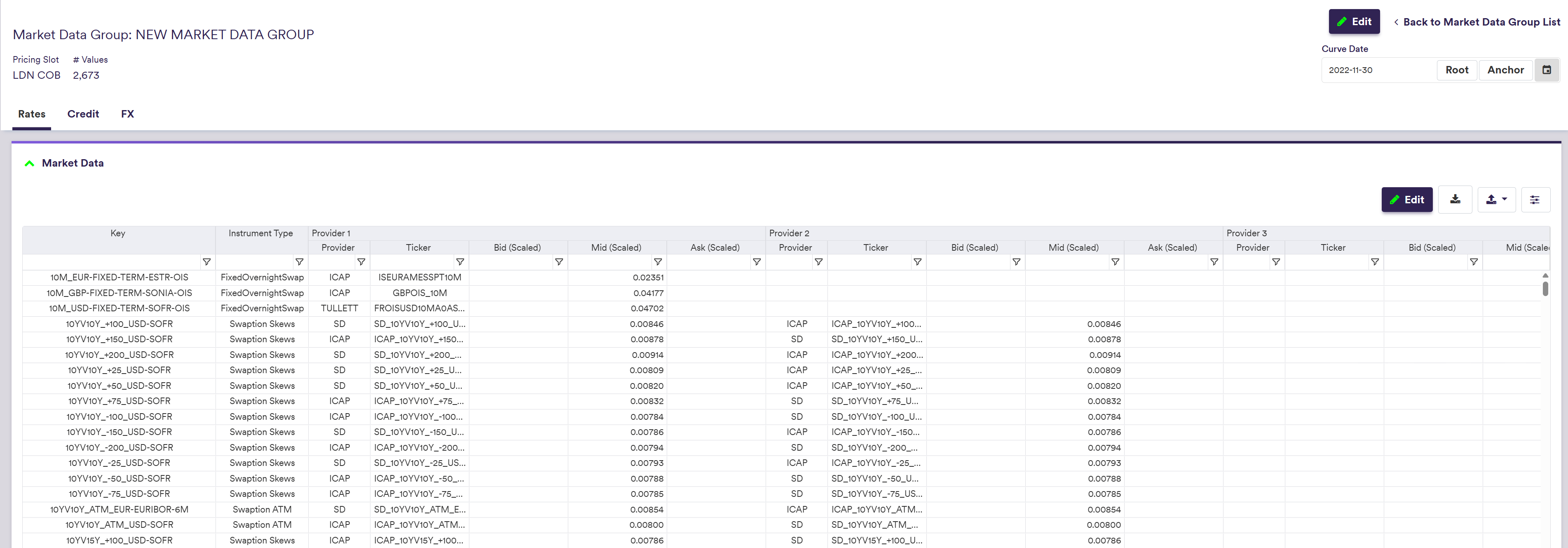
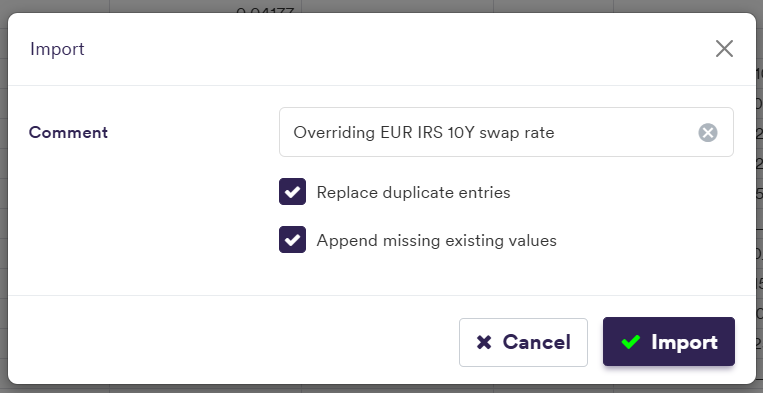
You will need to select the option to Replace duplicate entries to override the existing EUR 10y swap rate (vs. EURIBOR 6M) with the corrupted market data and to Append missing existing values that are not in the import file (see the versioning page for more detail).
Applying MDK filter '10Y_EUR-FIXED-1Y-EURIBOR-6M'

To restore the initial market data environment, you will need to import overriding data without anomaly. The .CSV import file with initial market data can be downloaded here.
Again, you will need to select the option to Replace duplicate entries to override the existing corrupted market data and to Append missing existing values that are not in the import file.
Starting a Market Data Cleansing Workflow
Once you have met the generic prerequisites and have a default pricing environment ready (see above for our worked example), you can start a market data cleansing workflow by creating a dashboard.
You can then monitor the key steps of its progress at the dashboard level.
At any point of the market data cleansing workflow, at the dashboard level, you can re-run a (selection of) stream(s) from the current clearing phase.
You can view and export the results of the data cleansing process “as-you-go”, including raw, preliminary cleansed and overlay cleansed data (as described in the key steps of the workflow) and corresponding market data sources.
To create a market data cleansing dashboard:
- click on
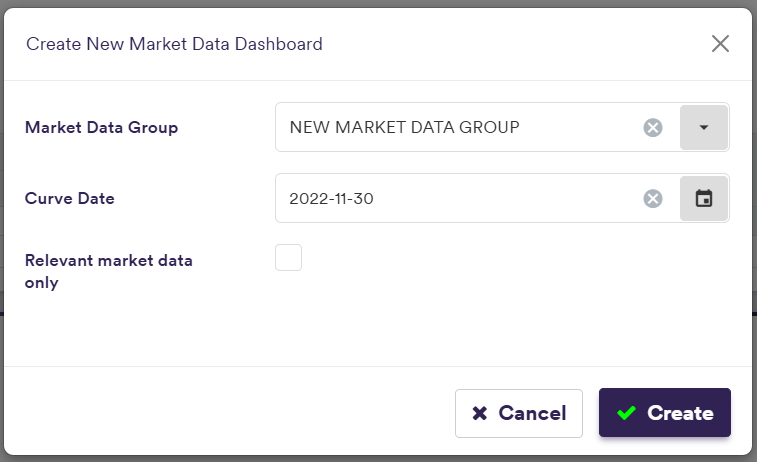
Add New (or view an exiting one by double-clicking on the line item) - input the relevant parameters (i.e. market data group, curve date and select ‘Relevant market data only’ if applicable)
- click on
Create
Data Cleansing/Market Data

setting Market Data Group = 'NEW Market Data GROUP' and Curve Date = '2022-11-30'
Data Cleansing/Market Data
Data Cleansing/Market Data/Market Data Cleansing Dashboard

Relevant Market Data Only
If you select to perform data cleansing on ‘Relevant market data only’, those will be identified as market data required to value portfolio trades linked to the market data group in each company/entity’s default valuation settings.
If you do not select this option, all market data associated to the market data group will be included in the data cleansing process.
| Field Name | Description | Permissible Values |
|---|---|---|
| (TRS) Market Data Group | The data group that contains the raw (TRS) market data | Any existing (TRS) market data group |
| Curve Date | The curve date (set by default to the system's anchor date) | YYYY-MM-DD (ISO 8601) |
| Relevant market data only | Whether to clean all market data or only data required to value the portfolios associated to the market data group (via the parent Company / Entity's valuation settings) | Boolean |
You can now start the market data cleansing workflow by clicking on
After clicking on
Data Cleansing/Market Data

Under
- from ‘Not Started’, after clicking on
Create - to ‘In Progress’, after clicking on
Run - to ‘Completed’, once all break test phases have been completed (i.e. any actual breaks identified during break testing were successfully resolved and approved)
%%{init:{
  'flowchart':{
    'nodeSpacing': 50,
    'rankSpacing': 50,
    'diagramPadding': 5
  }
}}%%
flowchart TB

A["Not Started"]
B["In Progress"]
C["Completed"]

subgraph title[Dashboard Status]
A --> B
B --> C
end

classDef subgraphStyle font-weight:bold,fill:none,stroke:#805CDD,stroke-width:1px;
classDef xplStyle fill:#805CDD,stroke:#333,stroke-width:1px,color:#fff;

class title subgraphStyle;
class A,B,C xplStyle;
You can monitor the key steps of the market data cleansing workflow progress in more detail at the dashboard level, as described in the section below.
Key Steps of the Market Data Cleansing Workflow
Under
In this section, we will discuss:
- how break tests are applied on market data
- how break test resolution and approval are performed on a stream basis
The three main phases of the market data cleansing workflow which can be viewed in the dashboard are:
- The ‘Market Data Upload’ phase
- The ‘Preliminary Breaks’ phase (*)
- The ‘Overlay Breaks’ phase (**)
After loading the relevant market data, Xplain will perform break testing for the Preliminary and Overlay break test phases, as described in the 1. Market Data Cleansing Break Testing section below.
Each break test phase will be split into streams, as described in the 2. Break Test Phase Streams section below. The resolution and approval of the breaks can then be done in parallel on a stream basis.
For more detail on preliminary and overlay break tests for market data, please refer to the break test definitions page.
Data Cleansing/Market Data/Market Data Dashboard

The overall status of each break test phase are as follows:
%%{init:{
  'flowchart':{
    'nodeSpacing': 50,
    'rankSpacing': 50,
    'diagramPadding': 5
  }
}}%%
flowchart TB

A["Not Started"]
B["In Progress"]
C["Completed"]

subgraph title[Break Test Phase Status]
A --> B
B --> C
end

classDef subgraphStyle font-weight:bold,fill:none,stroke:#805CDD,stroke-width:1px;
classDef xplStyle fill:#805CDD,stroke:#333,stroke-width:1px,color:#fff;

class title subgraphStyle;
class A,B,C xplStyle;
The status of a break test phase will be a function of the status of its streams, which will evolve as described in the Break Test Phase Streams section below. It will be set to ‘Not Started’ if all its streams are either ‘Processing’ or ‘Pending Resolution’, to ‘In Progress’ if at least one of its streams is beyond ‘Pending Resolution’, and to ‘Completed’ if all its streams are ‘Approved’.
Data Cleansing/Market Data/Market Data Dashboard

On an instrument basis, once all breaks have been resolved and approved (i.e. status is ‘Verified’), you can view the corresponding market data cleansing results at the dashboard level.
If you have imported corrupted market data to ‘NEW MARKET DATA GROUP’ to trigger a break during the market data cleansing workflow, you can now either restore the original market data (as described above) or perform curve calibration and portfolio valuation using the overlay cleansed data.
1. Market Data Cleansing Break Testing
For each curve node and volatility point, Xplain automatically generates a unique identifier, referred to as a market data key (MDK), which is derived from the instrument’s characteristics (e.g. tenor) and the underlying index convention. MDKs are used to map a curve node or a volatility point to the relevant market data.
If, when creating the dashboard, you have opted to perform market data cleansing only on data that are required to value the portfolios associated to the market data group (via the parent Company / Entity’s valuation settings), only those market data will be considered for break test calculations. Otherwise, all market data associated to a given curve configuration will be cleansed.
Preliminary break tests are performed for each [MDK + market data provider] combination. For example, when identifying missing data, if a curve node type is linked to two providers, the ‘NULL’ break test (which you cannot disabled) will be applied twice, once for each provider. This will result in up to two breaks to resolve.
The output resulting from a preliminary break resolution will be deemed to be the Preliminary Cleansed Data.
Overlay break tests are applied on an MDK basis, based on the Preliminary Cleansed Data.
The effective number of successfully applied tests will be reported in the dashboard, but tests that cannot be performed if an underlying data is missing (e.g. a ‘NULL’ value or no previous data available for a day-on-day test) will not trigger a break.
You will need to resolve any actual breaks within a given stream, as described in the Break Test Phase Streams section below.
For day-on-day tests, the ‘previous day’ will be defined as the latest date prior to the current date on which there is any market data available for the market data group in scope. If such data is missing, day-on-day tests will not be performed.
2. Break Test Phase Streams
Following break testing (preliminary and overlay), you will need to resolve any actual breaks within a given stream. Streams are defined according to the task granularity settings, with the ‘Overlay Breaks’ phase split by curve configuration first.
On the Market Data Cleansing Break Test - Resolver page, we will start guiding you through the break test resolution process for market data.
More specifically, you can refer directly to the following pages for more detail on:
For each stream with breaks, a resolution task will be generated, that can be checked out then under
Once checked out, the status of the resolution task will go from ‘Pending Resolution’ to ‘In Resolution’. Following the first submission of a proposed resolution (as described in the Market Data Break Clearing - Resolver page), an approval task will be generated, that can also be checked out then. Likewise, once checked out, the status of the approval task will go from ‘Pending Approval’ to ‘In Approval’.
If the resolution is rejected (as described in the Market Data Break Clearing - Approver page), if no longer live, the resolution task will be visible again with the status ‘In Resolution’, and will need to be re-opened by the original resolver.
Likewise, if no longer live, the approval task will be visible again with the status ‘In Approval’, and will need to be re-opened by the original approver.
While there is no live approval task, the initial status of the stream will be ‘Pending Resolution’, and it will evolve as described in the diagram below. As we allow for partial break clearing, breaks within a stream may be at a different stage of the clearing process. For instance, some items may already be waiting for approval where some others may still be waiting for resolution, in which case the status of the stream will be set to ‘Hybrid’ (i.e. there is both a live resolution task and a live approval task).
%%{init:{
  'flowchart':{
    'nodeSpacing': 50,
    'rankSpacing': 50,
    'diagramPadding': 5
  }
}}%%
flowchart TB

A["Pending Resolution"]
B["In Resolution"]
C["Hybrid"]
D["Pending Approval"]
E["In Approval"]
F["Completed"]

subgraph title["Stream Status"]
A --> B
B --> D
D --> E
E --> F
B <--> C
C <--> E
E <--> B
end

classDef subgraphStyle font-weight:bold,fill:none,stroke:#805CDD,stroke-width:1px;
classDef xplStyle fill:#805CDD,stroke:#333,stroke-width:1px,color:#fff;

class title subgraphStyle;
class A,B,C,D,E,F xplStyle;
When expanded, the information related to a break test phase will set out the status of each stream.
Data Cleansing/Market Data/Market Data Dashboard
Generating Xplain Valuation Data
This section is only relevant if Xplain is one of the valuation data providers in a valuation data cleansing workflow (Xplain valuation data).
In that case, you will not have to import any valuation data for Xplain in the relevant valuation data group that will comprise third-party data only. Instead, once a market data cleansing workflow is completed, you will be able to use the cleansed market data to generate the required Xplain valuation data, which will be stored in a ‘Dashboard Validated - Overlay’ calculation result.
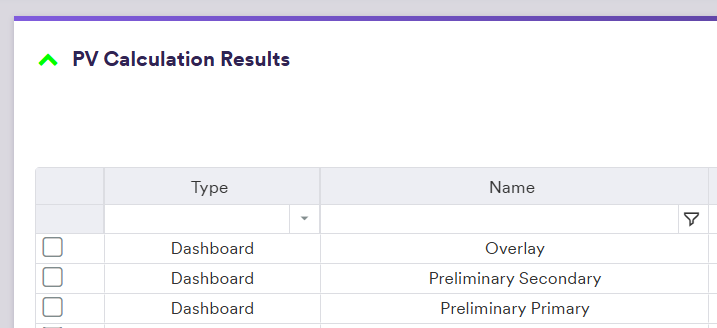
First, based upon company/entity’s default valuation settings, three sets of Xplain valuations will be calculated corresponding to the three types of cleansed market data: ‘Preliminary Primary’, ‘Preliminary Secondary’ and ‘Overlay’.
Under
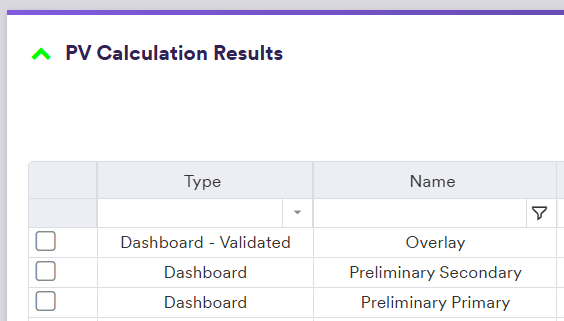
The three sets of Xplain valuations will be saved as the following PV calculation results:
- ‘Dashboard - Preliminary Primary’
- ‘Dashboard - Preliminary Secondary’
- ‘Dashboard - Overlay’
Data Cleansing/Market Data/Market Data Dashboard

Valuations/Valuation Results
To validate the ‘Dashboard - Overlay’ calculation results, you can generate various comparison metrics based on the three sets of valuations by clicking on
Data Cleansing/Market Data/Market Data Dashboard
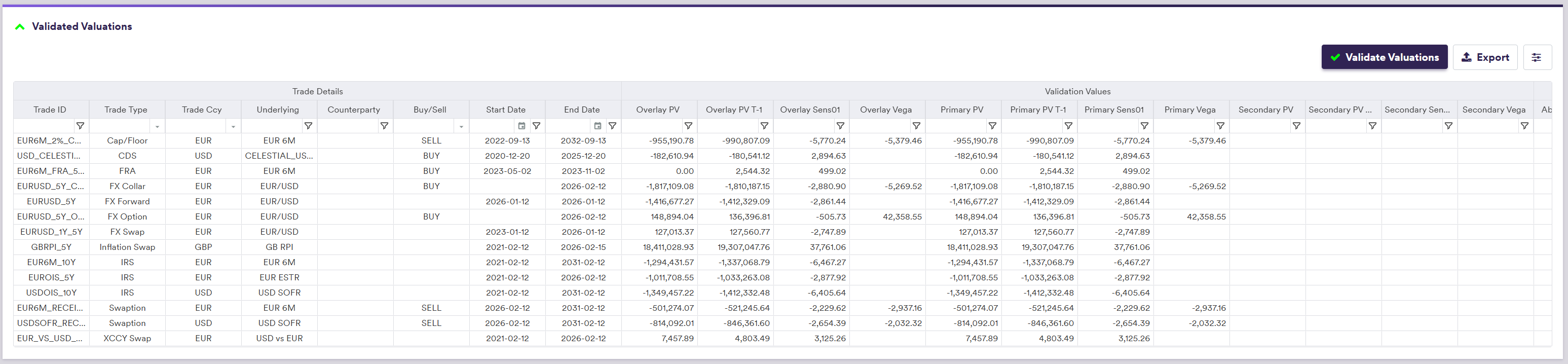
Upon validation, the ‘Dashboard - Overlay’ calculation results will be renamed as ‘Dashboard Validated - Overlay’ and will be the data source for Xplain valuation data in the valuation data cleansing workflow.
Valuations/Valuation Results
Re-running a Stream
At any point of the market data cleansing workflow, at the dashboard level, you can re-run the data cleansing process for a (selection of) stream(s).
After selecting the stream(s) you wish to re-run, click on
-
Selecting ‘Re-run all’ will delete all resolution/approval records and re-run all applicable break tests for all market data keys within a given stream. (1)
-
Selecting ‘Re-run with Updated Data Only (base = raw primary)’ will only focus on market data keys with updated market data and re-run only applicable break tests with updated underlying market data. In other words, this option will not impact break resolution in respect of market data keys with unchanged market data. Note that the base market data will be the raw primary market data.
-
Selecting ‘Re-run with Updated Data Only (base = verified if raw primary unchanged)’ will similarly only focus on market data keys with updated market data. The difference is that the base market data will be the verified overlay market data (if available). Note that if the raw primary market data has changed, the verified overlay market data will not be used and the break tests will be re-run with the raw primary market data as the base.
If the ‘Relevant market data only’ filter has been applied at the start of the data cleansing workflow, all re-run options will take into account the latest applicable trade universe (i.e. including new trades and removing archived trades) to determine which market data keys are in scope for re-run.
